Geometry and Spectra of Compact Riemann Surfaces
and related topics
About
A conference in geometric topology and spectral geometry.
The schedule is posted below. Unfortunately, Laura Monk had to cancel her talk. There will be a small reception on Wednesday after the lightning talks.
Registration
Registration is now closed.
Speakers
Ara Basmajian
Short geodesics and intersection number on hyperbolic surfaces
There are many geometric and topological invariants one can associate with homotopy classes of closed curves. These include algebraic and geometric self-intersection number, intersection with curves in a class of curves (for example, simple ones), mapping class group stabilizers of a curve, and many others. How these invariants interact and determine the curve type (mapping class group orbit) is an active area of research today.
In this talk, we consider the relationship, in various settings, between length and self-intersection. One such setting we will discuss involves the so-called inf invariant (shortest length among all metrics) for a closed curve, and its relationship with the geometric self-intersection number and the optimal (designer) metric that is tailored to produce the minimum length.
Yves de Cornulier
Distortion in groups
A finitely generated subgroup of a finitely generated group admits two natural word (Cayley graph) metrics: that of the subgroup and that of the ambient group. The subgroup is said to be undistorted if these two metrics are equivalent (i.e., the ratio between the two is bounded away from 0 and infinity), and distorted otherwise. I will first survey the notion of distortion in groups, with an emphasis on cyclic subgroups. Then I will address the question of finding distorted abelian subgroups of minimal rank in semidirect products ℤd ⋊ ℤ. This question turns out to have a number-theoretic flavor.
Gilles Courtois
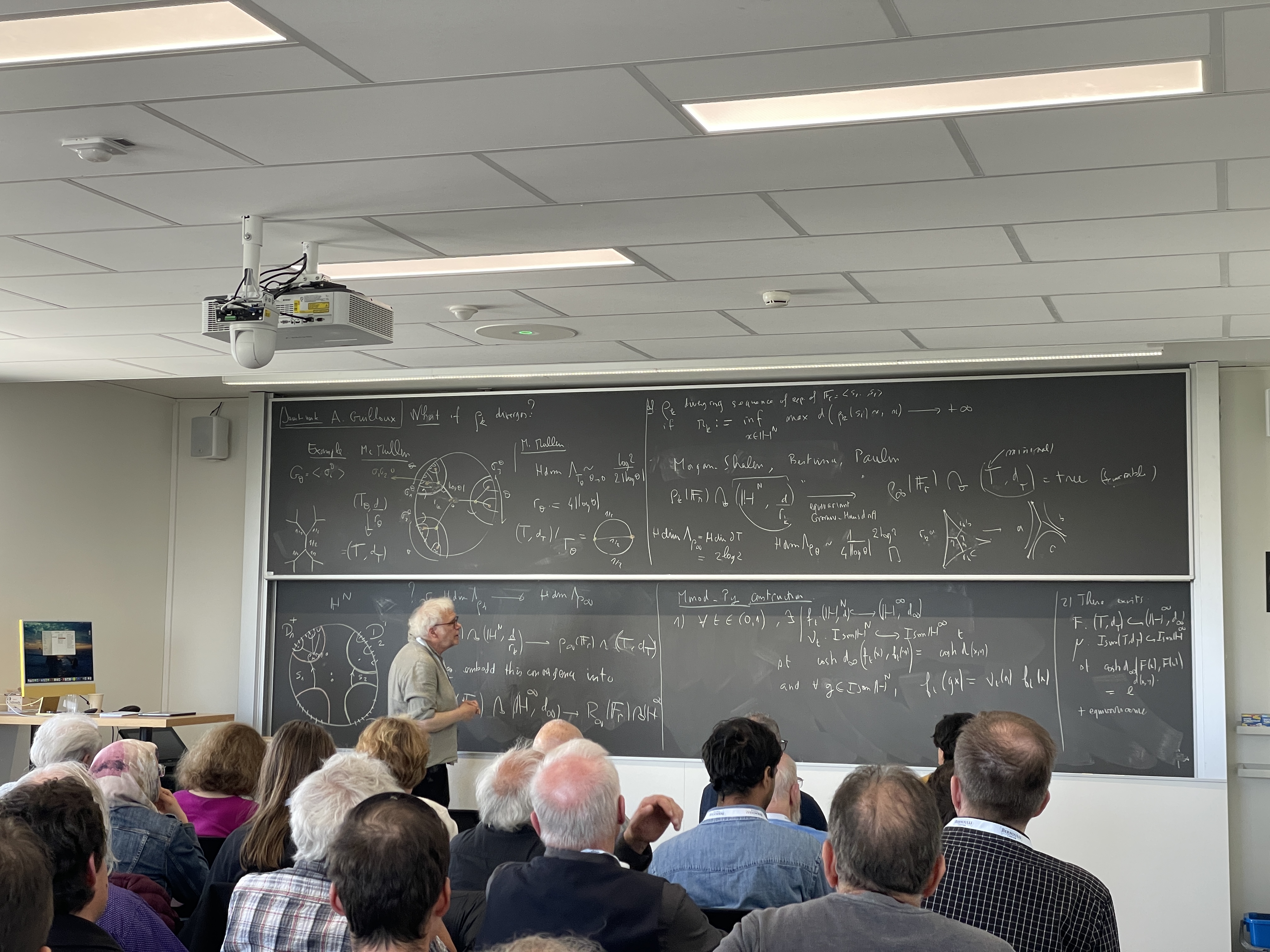
Limit sets of divergent sequences of Schottky groups
For a divergent sequence of Schottky groups in the hyperbolic space
ℍN, the Hausdorff dimension of their limit sets tends to 0.
By embedding these groups into the group of isometries of infinite-dimensional hyperbolic space,
we determine the rate of convergence. (Joint work with Antonin Guilloux.)
Asma Hassannezhad
Geometry of Small Laplace and Steklov Eigenvalues
In this talk, we review classical results on how geometry influences the small eigenvalues of the Laplace-Beltrami operator on surfaces. Then we discuss recent work extending this picture to Steklov eigenvalues on hyperbolic surfaces.
Bruno Martelli
A 4-dimensional pseudo-Anosov homeomorphism
We know from work of Thurston that every surface S of negative Euler characteristic admits plenty of pseudo-Anosov homeomorphisms, and that their mapping torus is always a hyperbolic 3-manifold. It is natural to ask whether such a picture has some higher-dimensional analogues. We describe one case where it does: we propose a higher-dimensional generalization of the notion of pseudo-Anosov homeomorphism, and build one 4-dimensional case whose mapping torus is a hyperbolic 5-manifold.
Bram Petri
Random hyperbolic surfaces with large systoles
The systole of a hyperbolic surface is the length of the shortest closed geodesic on that surface. How large the systole of a closed hyperbolic surface of a fixed genus can be is a classical question that is still mostly open. I will speak about joint work with Mingkun Liu on how random constructions can be used to build surfaces with large systoles.
Anna Roig Sanchis
Apollonian random manifolds and their bass notes
Given a hyperbolic manifold, the spectrum of its Laplacian contains a great deal of information about its geometric structure. In this talk, I will present joint work with Will Hide, Bram Petri and Joe Thomas in which we study the spectral gap -the first nonzero eigenvalue- of two models of random hyperbolic 3-orbifolds related to the Apollonian group. If time permits, I will also mention how this can be used to investigate the bass note spectrum of the set of hyperbolic 3-orbifolds.
Julie Rowlett
Good things come in threes… and sometimes fours!
I will talk about joint work with my students (Max Blom, Henrik Nordell, Oliver Thim, Jack Vahnberg) and more recently with Gustav Mårdby and Fabio Francesconi, in which we explore connections between the regularity of Laplace eigenfunctions, the geometry of polytopes, and algebraic structures.
Schedule
All talks take place in the main room of the Bernoulli Center.
| Wednesday | Thursday | Friday |
|---|---|---|
|
10:00-10:50
Yves de Cornulier
|
9:00-9:50
Bram Petri
|
|
|
11:00-11:30
Coffee break
|
10:00-10:30
Coffee break
|
|
|
11:30-12:20
Anna Roig Sanchis
|
10:30-11:20
Asma Hassannezhad
|
|
|
11:45-12:35
Bruno Martelli
|
||
|
14:30-15:20
Gilles Courtois
|
14:30-15:20
Ara Basmajian
|
|
|
15:30-16:00
Coffee break
|
15:30-16:00
Coffee break
|
|
|
16:00-16:50
Julie Rowlett
|
16:00-16:50
Lightning talks
|
|
|
17:15-18:00
Lightning talks
|
Sponsors
- The Bernoulli Center, EPFL
- Institute of Mathematics, EPFL
- Department of Mathematics, University of Fribourg
Poster
Download: BuserPosterFinal.pdf
Conference Photos
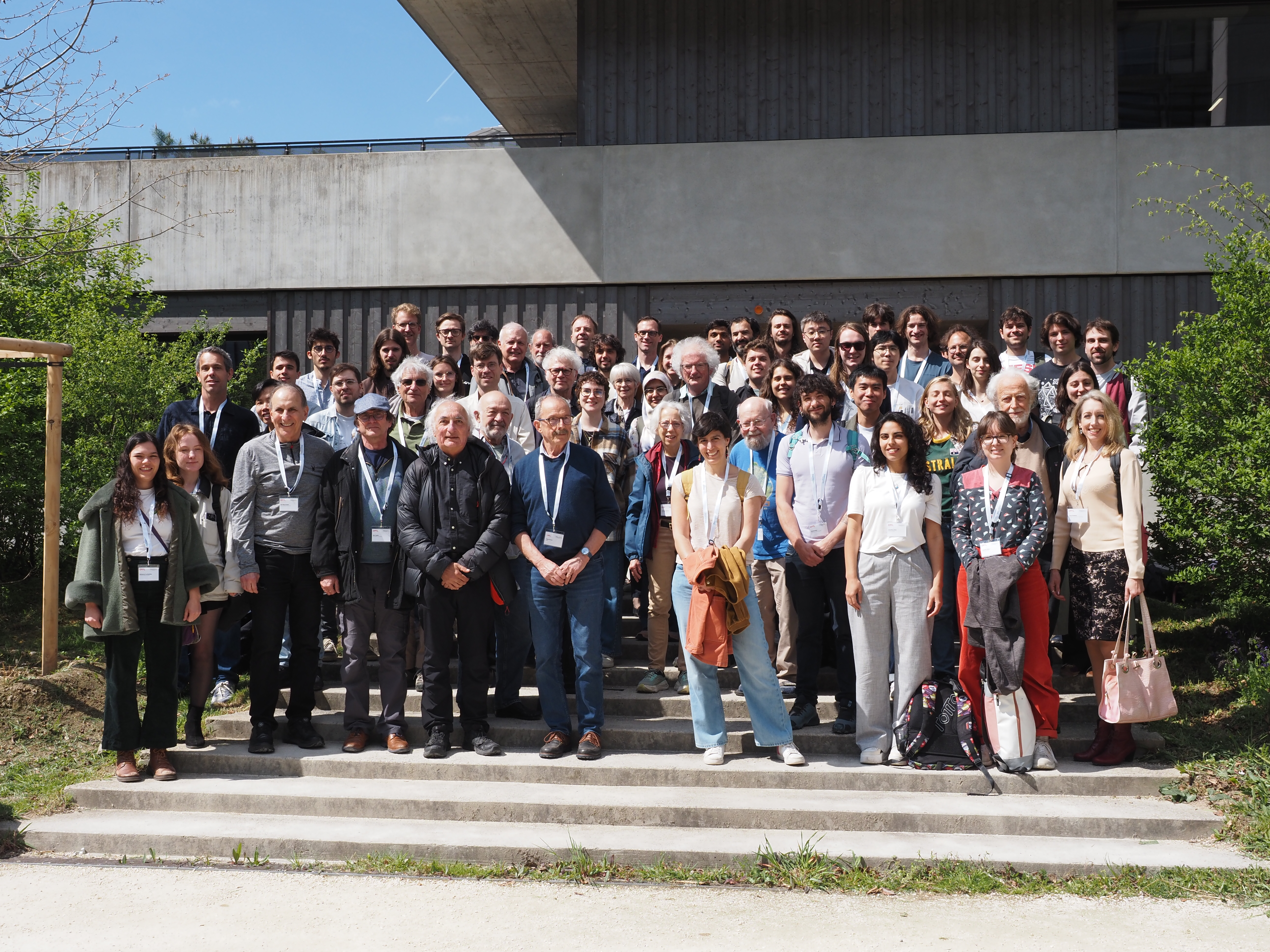
Participants
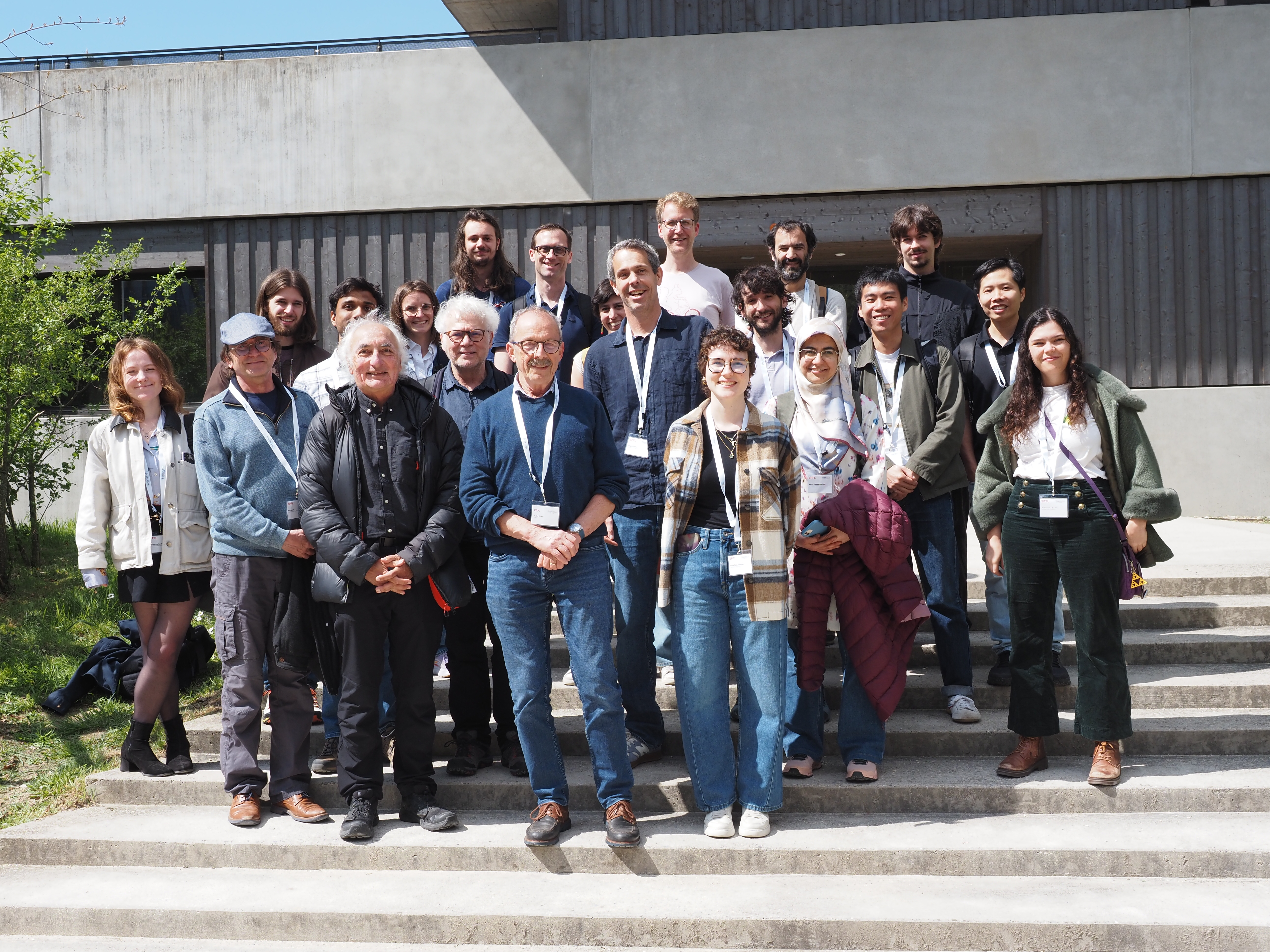
The Buser mathematical family
Organizers & contact
Organized by Federica Fanoni and Hugo Parlier
With vital help from Maroussia Schaffner Portillo, Christiane Maillard and the Bernoulli Center team
Contact information: bernoulli@epfl.ch, federica.fanoni@u-pec.fr and hugo.parlier@unifr.ch